
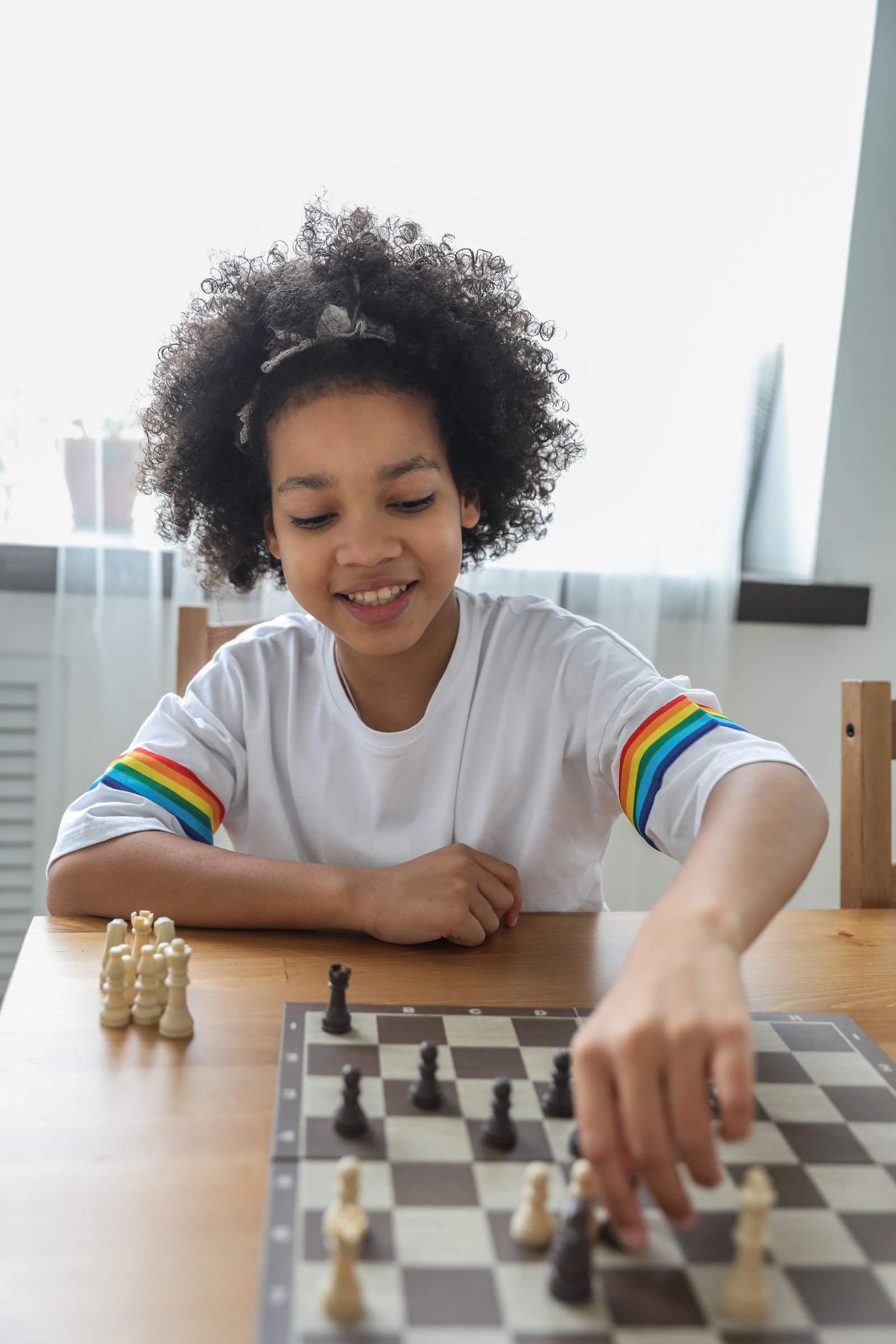
A twelve-year-old reaches for a piece, stops, and pulls their hand back. That half-second — the gap between impulse and action — is the entire premise of Chess for Peace. It is also, almost exactly, the skill that determines what happens when the same young person is provoked in a stairwell three days later. Boston youth empowerment programs that use chess are not teaching a hobby. They are rehearsing a decision-making sequence under low stakes so it is available under high ones.
The transfer problem, and why chess solves it
Every youth program eventually runs into the transfer problem. A young person can recite a de-escalation script perfectly in a workshop and forget every word of it in a real argument, because the workshop version was cognitive and the real version is physiological — heart rate up, attention narrowed, an audience watching.
Skills transfer best when they are practiced in conditions that share features with the target situation. Chess shares more of those features than most classroom exercises. There is a live opponent with competing goals. There is time pressure. There is an audience. There is a public record of your choices. And there is a real, if bounded, cost to a bad decision.
What chess strips away is the danger. A young person can lose a queen, feel the flush of frustration, and practice recovering from it with nothing actually at risk. Doing that fifty times over a season is meaningfully different from being told to count to ten.
Four habits the board builds
1. Pause before acting
The first thing every beginner learns is that the move that feels obvious is frequently the move that loses. Chess punishes the impulse and rewards the pause with immediate, unarguable feedback. No adult has to deliver the lesson; the position delivers it.
2. Read the other side
You cannot play competently without continually asking what your opponent is trying to accomplish. That is perspective-taking, practiced dozens of times per game. In a conflict, the same question — what is this person actually after — is the single most useful thing anyone can ask, and it is the first thing that disappears when someone is upset.
3. Map consequences
Every move opens some possibilities and forecloses others, visibly and immediately. Young players develop a working sense that choices have branching consequences, which is far more durable than being told that actions have consequences in the abstract.
4. Own the outcome
There is no referee to blame and no teammate who let you down. The position on the board is the sum of your own decisions. That is an uncomfortable and extremely valuable thing to internalize at thirteen.
Chess is not the point. The four-second habit of pausing, reading the other side, mapping the consequence, and owning the choice — that is the point.
What losing teaches
The most important moment in a chess program is not a victory. It is the third loss in a row.
A young person who has learned to treat a bad position as information rather than a verdict has acquired something that generalizes across nearly every domain they will enter. Academic setbacks stop reading as proof of inadequacy. Social rejection stops requiring retaliation to resolve. This is the difference, in the language of achievement research, between attributing failure to a fixed trait and attributing it to a strategy that can be adjusted.
Coaches make or break this. The response to a loss should be a question, not consolation: where do you think the position turned? Show me the move you would take back. That reframing — from "I am bad at this" to "that specific move was weak" — is the entire lesson, and it takes about ninety seconds to deliver well.
The part nobody puts in the brochure
The cognitive case for chess is real. The social case may matter more.
A weekly room where someone knows your name, expects you, and notices if you are absent is a genuine protective factor for an adolescent. Isolation is one of the more reliable precursors to the outcomes community programs exist to prevent. Chess nights work partly because of the board and partly because they are an excuse for people to sit together for two hours without a screen.
Chess also has an unusual property among youth activities: it is genuinely intergenerational and largely indifferent to physical size, athletic ability, or grade level. A thirteen-year-old can beat a sixty-year-old. A newcomer with limited English can compete on level terms from the first night. In a city as segmented as Boston, an activity that flattens those divisions is worth something on its own.
How to coach the transfer deliberately
Skills do not migrate off the board by themselves. Programs that assume they will are usually disappointed. At Chess for Peace we name the connection out loud, every session, in a ten-minute teaching block that pairs one tactic with one conflict resolution idea.
- Forced moves and ultimatums. A position with only one legal reply is a bad position. So is a conversation where the other person has been left no acceptable option.
- Development before attack. Building relationships before you need them is the same principle as developing pieces before launching an assault.
- The threat behind the move. Asking why an opponent played something maps directly onto asking what is underneath a sharp comment.
- Resigning versus flipping the board. There is a dignified way to end a losing position, and there is the other way. Both exist in arguments too.
- The post-game review. Players who review their games improve faster than players who simply play more. The same is true of families that talk about an argument afterward.
Naming these connections costs nothing and roughly doubles what participants take home.
Why we run it for whole families
Most chess programs are youth-only. Ours is deliberately not. Caregivers play alongside their children, which produces two things a youth-only program cannot.
First, modeling. A child who watches a parent lose a game gracefully learns more about handling frustration than any curriculum can deliver. Second, conversation. Parents consistently tell us that the exchanges happening between moves — unhurried, side by side, with a shared focus that is not the relationship itself — are the reason they keep coming back. Difficult subjects surface more easily when nobody has to maintain eye contact.
Starting a board in your neighborhood
If you want to bring this to a school, congregation, community center, or block in Dorchester, Roxbury, Mattapan, or anywhere in Greater Boston, the requirements are modest.
- A room and a recurring time. Consistency beats scale. One reliable weeknight builds more than four scattered events.
- Sets and clocks. We provide equipment for partner sites, and distribute take-home sets to families when donations allow.
- Two or three volunteers. Intermediate playing strength is plenty. Patience and warmth matter far more than rating.
- A teaching moment each session. Ten minutes connecting a tactic to a life skill, delivered plainly.
- A closing circle. Five minutes where anyone can name a good move, a hard loss, or something happening on the block.
Chess for Peace is free, open to all skill levels, and designed to travel. If your neighborhood wants one, we will bring the boards.
Support for young people
This article is educational and does not replace clinical care. If a young person is in immediate danger, call 911. For urgent support:
- 988 Suicide & Crisis Lifeline — call or text 988
- Crisis Text Line — text HOME to 741741
- Massachusetts Behavioral Health Help Line — 833-773-2445